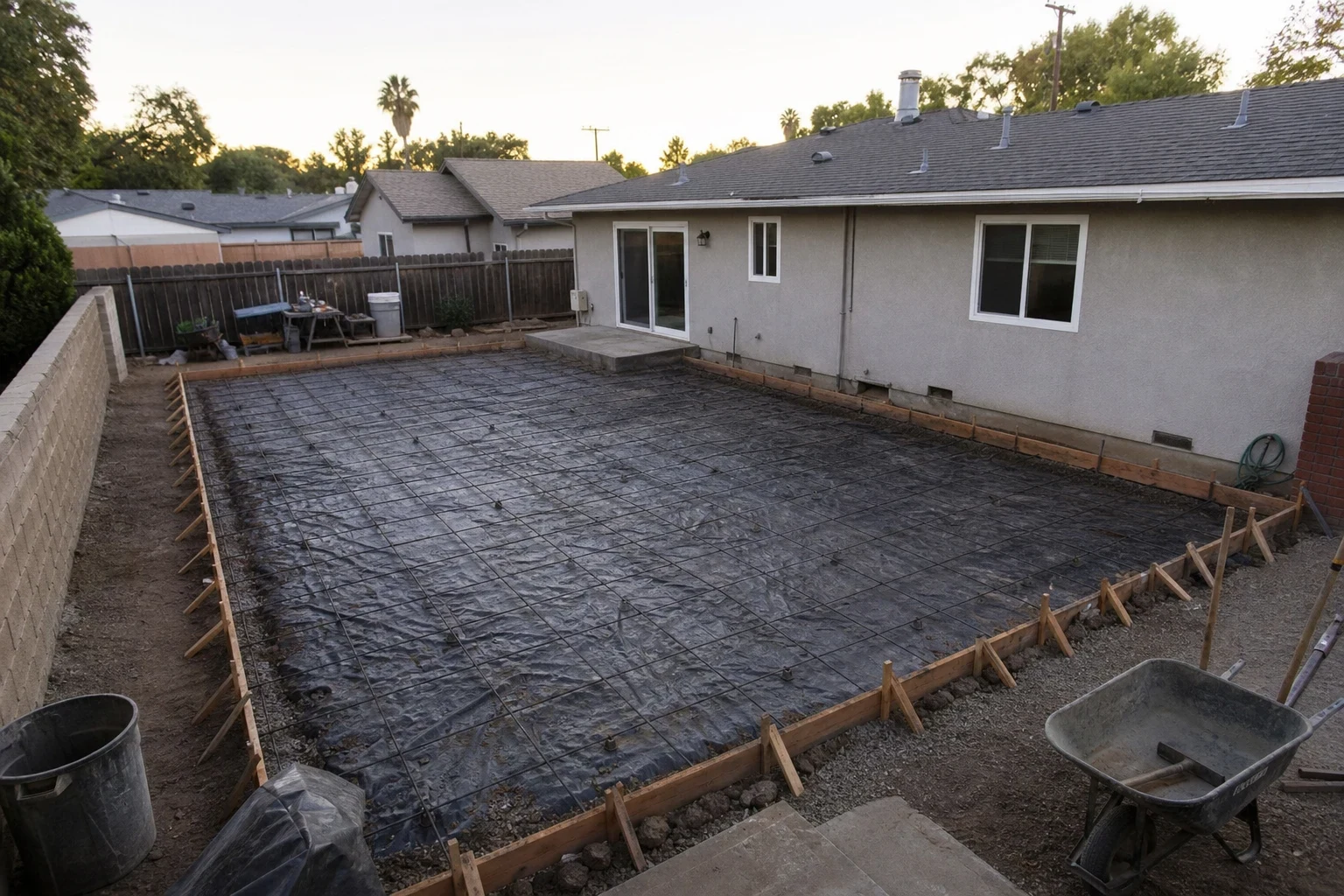
How Many Yards of Concrete for a 30x40 Slab in Tustin?
The math is short, but thickness, thickened edges and the grade underneath decide what actually goes on the truck.
How many yards of concrete does it take to pour a 30x40 slab?
A 30x40 slab poured 4 inches thick needs about 14.8 cubic yards of concrete, so most crews order 15.5 to 16 yards to cover waste and uneven grade. At 5 inches it is about 18.5 yards, and at 6 inches about 22.2 yards, before thickened edges or footings are added.
The basic volume math for a 30x40 slab
Concrete is sold by the cubic yard, and one cubic yard is 27 cubic feet. A 30x40 slab covers 1,200 square feet. Multiply that area by the thickness in feet, then divide by 27 to get yards.
Thickness is where people slip up. Four inches is 0.333 feet, not 0.4. Using the wrong decimal on a slab this size throws the order off by more than two yards.
- 4 inches: 1,200 x 0.333 = 400 cubic feet, or about 14.8 yards
- 5 inches: 1,200 x 0.417 = 500 cubic feet, or about 18.5 yards
- 6 inches: 1,200 x 0.5 = 600 cubic feet, or about 22.2 yards
Which thickness does your slab need
Four inches is the usual starting point for a patio, a shed floor or a slab that only sees foot traffic and light storage. Once vehicles are involved, we move up. A two-car garage floor or workshop with a heavy truck parked on it usually gets 5 inches, and a pad for an RV, a boat on a trailer or a loaded box truck often gets 6 inches with heavier reinforcement.
The reason is load spread. A thicker section spreads a concentrated tire load over more of the soil underneath, so the slab is less likely to crack at the corners where it has the least support. Reinforcement, whether rebar on chairs or wire mesh, holds cracks tight but does not replace thickness.
If the slab will carry a building, such as a detached garage or a workshop, the thickness and footing design come from the structural plans and the permit, not from a rule of thumb.
Thickened edges and footings add more yards than you expect
Many 30x40 slabs are not one even thickness. The perimeter is often turned down into a thickened edge so the slab can carry wall loads or resist edge cracking. That extra concrete runs the full 140-foot perimeter, so it adds up fast.
As an example, a thickened edge 12 inches wide that drops to 12 inches deep on a 4-inch slab adds 8 inches of depth along the whole perimeter. That is 140 x 1 x 0.667, or about 93 cubic feet, which is close to 3.5 more yards. Interior footings under posts or a center bearing line add more on top of that.
- Add the perimeter edge volume separately from the flat slab
- Count any interior pad footings one by one
- Include ramps or aprons poured at the same time
Why you order extra, and how much
The subgrade is never perfectly flat. A half inch low spot across a few hundred square feet soaks up concrete you did not count. Forms can bow slightly, some material stays in the chute and the pump line, and a little spills during placement. That is why we add 5 to 10 percent to the calculated volume.
Running short is the costly mistake. If the last truck comes up a yard light, the crew has to wait for a short load while the concrete already placed keeps setting. That can leave a cold joint, a weak seam where fresh concrete meets material that has started to cure. On a 4-inch 30x40 slab, ordering around 16 yards instead of 14.8 is a small cost that protects against that.
Ready-mix trucks typically carry up to about 10 yards, so a slab this size is usually two truckloads. We time the second truck so it arrives as the first is finishing discharge.
What we check before ordering for a Tustin slab
Volume only works if the base is right. We compact the subgrade, place and compact a layer of crushed aggregate base, and check grade with a laser so the thickness is consistent across all 1,200 square feet. If the slab will sit under a conditioned space, such as a garage converted to a gym or office, a vapor barrier under the concrete keeps ground moisture out, and that helps the room hold a steady temperature and humidity instead of feeling damp and cool underfoot.
Summer afternoons in Tustin speed up how fast concrete sets, which shortens the window for finishing a large slab. We schedule big pours for early morning and plan the crew size so the whole surface gets finished and cured properly. A slab that will support a structure generally needs a building permit from the city, and the approved plans set the final thickness and footing sizes that the yardage is based on.
More questions about pouring a 30x40 slab
Something not covered here? (714) 733-1781
Can I mix a 30x40 slab myself from bags?
Not realistically. At 4 inches you would need roughly 900 60-pound bags before waste, and you could not mix and place them fast enough to avoid cold joints. A slab this size is a ready-mix truck job.
Does the concrete strength change how many yards I need?
No. The mix strength, such as 3,000 or 4,000 psi, affects how the slab handles load and weather, not the volume. The yardage comes only from the dimensions and thickness.
Should the slab be pitched for drainage?
Yes, an exterior slab is usually sloped slightly, often about an eighth to a quarter inch per foot, so water runs off instead of pooling. We build that slope into the forms and base so it does not change the average thickness.
How soon can I use a new 30x40 slab?
Foot traffic is usually fine after a day or two, and light vehicles after about a week. Concrete keeps gaining strength for roughly 28 days, so heavy loads like an RV or framing a building should wait until the mix has cured.
Get your 30x40 slab figured out by phone
Tell us the size, what the slab will carry and whether it supports a structure. We will walk through the right thickness, edge details and base, then give you your quote by phone.