ServicesWalkways and Sidewalks
Concrete Walkways and Sidewalks in Tustin
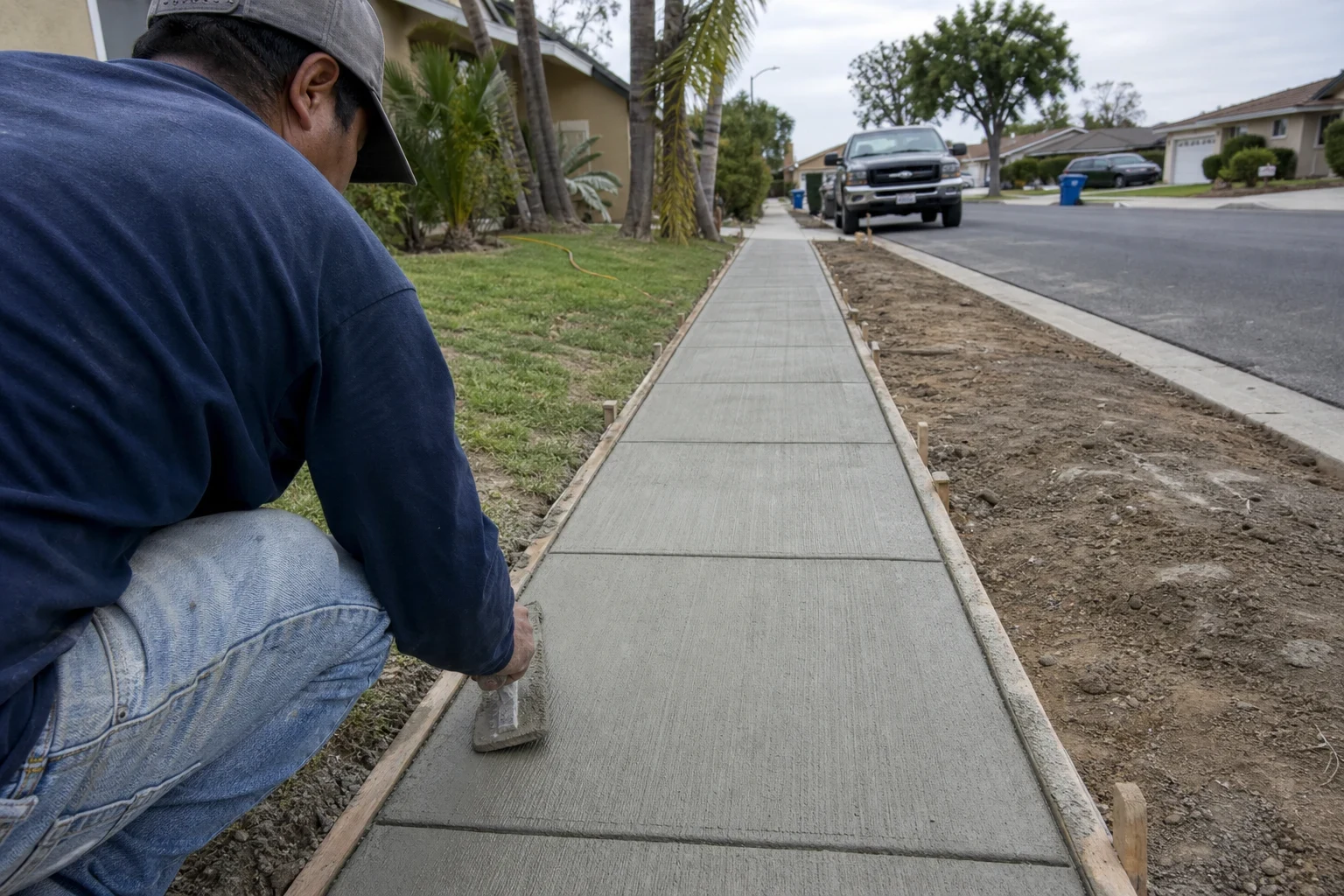
We tear out heaved, cracked or worn paths and pour new concrete walkways with a compacted base, a gentle slope away from your home and control joints cut at the right spacing. You get a flat, slip-resistant path that drains and stays put.
What a Well-Built Walkway Does
A walkway looks simple, but most failures start below the surface. Thin pours over loose fill settle, roots lift unreinforced panels, and a path laid flat or tilted toward the house sends rainwater straight to the foundation. We build the parts you never see first: excavation to firm soil, a layer of compacted crushed aggregate, steel reinforcement and forms set to a measured fall.
We pour front entry walks, side paths to the gate, garden walkways and the stretch of sidewalk in front of your home. Standard walks are 4 inches thick, and we finish the surface with a medium broom texture so it grips when wet from sprinklers or winter rain.
There is a comfort benefit too. Plain gray or light-tinted concrete reflects more sunlight than asphalt or dark pavers, so it stays cooler underfoot on a summer afternoon and gives off less stored heat next to walls and windows along the path.
What Your Walkway Project Includes
Removal and haul-off
We saw-cut clean edges where new concrete meets old, break out the existing walk or pavers, and haul the debris away. Roots that lifted the old panels are cut back at the edge of the path.
Compacted aggregate base
We excavate to undisturbed soil and place crushed aggregate base, compacted with a plate compactor. A firm, even base is what keeps panels from rocking or sinking later.
Reinforcement and joints
Rebar or welded wire mesh sits on chairs in the middle of the slab, not on the dirt. Expansion material goes where the walk meets the foundation, the driveway or steps, so each slab can move without pushing on the other.
Slope and drainage
We set forms to carry water off the surface and away from your home, typically about a quarter inch of fall per foot. No puddles at the door and no runoff against the stucco.
Finish and edges
A broom finish for traction, tooled edges that resist chipping, and control joints spaced roughly as far apart as the walk is wide. If you want color or a pattern, we can match it to stamped concrete elsewhere on the property.
Signs It Is Time for a New Walkway
Lifted panels and trip edges
When tree roots or expansive clay push one panel above the next, the lip catches toes and walker wheels. Once a panel is tipped and cracked across, replacing that run on a proper base is the lasting fix.
Water pooling by the door
A walk that holds water after rain or sprinklers was poured without enough fall, or has settled toward the house. That moisture ends up at your foundation and entry.
Crumbling or scaling surface
Flaking, exposed stone and powdery spots usually point to a weak mix or too much water added at the pour. The surface will keep wearing away.
Loose pavers or stepping stones
Pavers that shift, sink and sprout weeds need constant resetting. A concrete walk gives you one continuous surface that stays where it was placed.
A dirt path worn through the lawn
If everyone cuts across the grass to the side gate or backyard, that is where a walkway belongs. We lay it out along the route people already take.
How the Job Runs
- 1
Measure and lay out
We walk the route together, take grade readings with a level, and mark the width, any curves and the points where the walk ties into steps, the driveway or a gate. Afterward we put the price in writing, broken out by demolition, base, concrete and finish.
- 2
Demolition and base
The first day typically covers tear-out, digging down to firm soil and compacting the aggregate base. We shield nearby plantings and keep a usable route to your front door wherever the layout allows.
- 3
Forms, steel and pour
Forms are staked to the planned fall, steel is lifted onto chairs, and the concrete is placed, screeded and floated. When the forecast is hot, dry or windy, we schedule the pour early in the day and apply curing compound so the surface does not lose moisture too quickly.
- 4
Finish and joints
Edges get tooled, control joints are grooved or saw-cut at the planned spacing, and the broom texture goes on once the surface has firmed up enough to hold it.
- 5
Cure and cleanup
Once the concrete has set, we strip the forms, backfill soil along the edges and clear out the work area. You can usually walk on it after 24 to 48 hours.
What Moves the Price of a Walkway
Every walkway is priced from its own measurements and conditions, so we quote after seeing the site. The written estimate breaks out demolition, base, concrete and finish so you can see where the money goes and nothing is added later.
- Length, width and thickness
- Square footage drives the amount of concrete, base rock and steel. A wider entry walk or a thicker section where carts or bins roll costs more material.
- What comes out first
- Breaking out an old reinforced walk takes more labor and haul-off than clearing pavers or bare soil. Large roots in the path add time.
- Access and delivery
- If the truck can reach the forms, we chute the concrete directly. A narrow side yard may mean a pump or wheelbarrows, which adds labor.
- Finish and design
- A broom finish is the simplest. Curves, color, stamped patterns or decorative borders add forming and finishing time.
- Grade changes and permits
- Slopes that need steps or retaining edges add work. Sidewalk in the public right-of-way usually needs a city encroachment permit, which we pull when it applies.
Questions We Hear About New Walks
Something not covered here? (714) 733-1781
When is a fresh walk ready for foot traffic?
Most walks can take light foot traffic 24 to 48 hours after the pour. Concrete keeps gaining strength for roughly 28 days, so hold off on rolling heavy carts, dollies or wheelbarrows across it for about the first week. Before we leave, we go over curing instructions with you.
Will my new walkway crack?
Concrete shrinks as it cures, and some cracking is normal. Control joints give that shrinkage a planned place to go, so cracks form in the joints instead of across the panel. A compacted base and reinforcement keep any crack that does appear from opening up or offsetting.
Do I need a permit for a walkway or sidewalk?
A walkway on your own lot usually does not need one. Replacing the public sidewalk in front of your home is a different case, since that strip belongs to the city and generally requires an encroachment permit and inspection. We tell you which applies and handle the paperwork.
Can you match the new walk to my existing concrete?
We can match the finish texture, joint pattern and edge profile closely. Color is harder because older concrete has weathered, so new gray will look lighter at first and blend in over time. If you want an exact color match, a tinted mix or matching a stamped concrete patio is an option.
Does a lighter walkway really stay cooler?
Yes. Standard gray concrete reflects considerably more sunlight than asphalt or dark pavers, so it heats up less and is more comfortable barefoot near a pool or lawn. Running alongside the house, it also stores less heat against walls and windows on summer afternoons.
Ready for a Path That Stays Flat
Tell us where the walk runs, how wide you want it and what is there now. We will set a time to measure, check the grade and go over the options with you.